
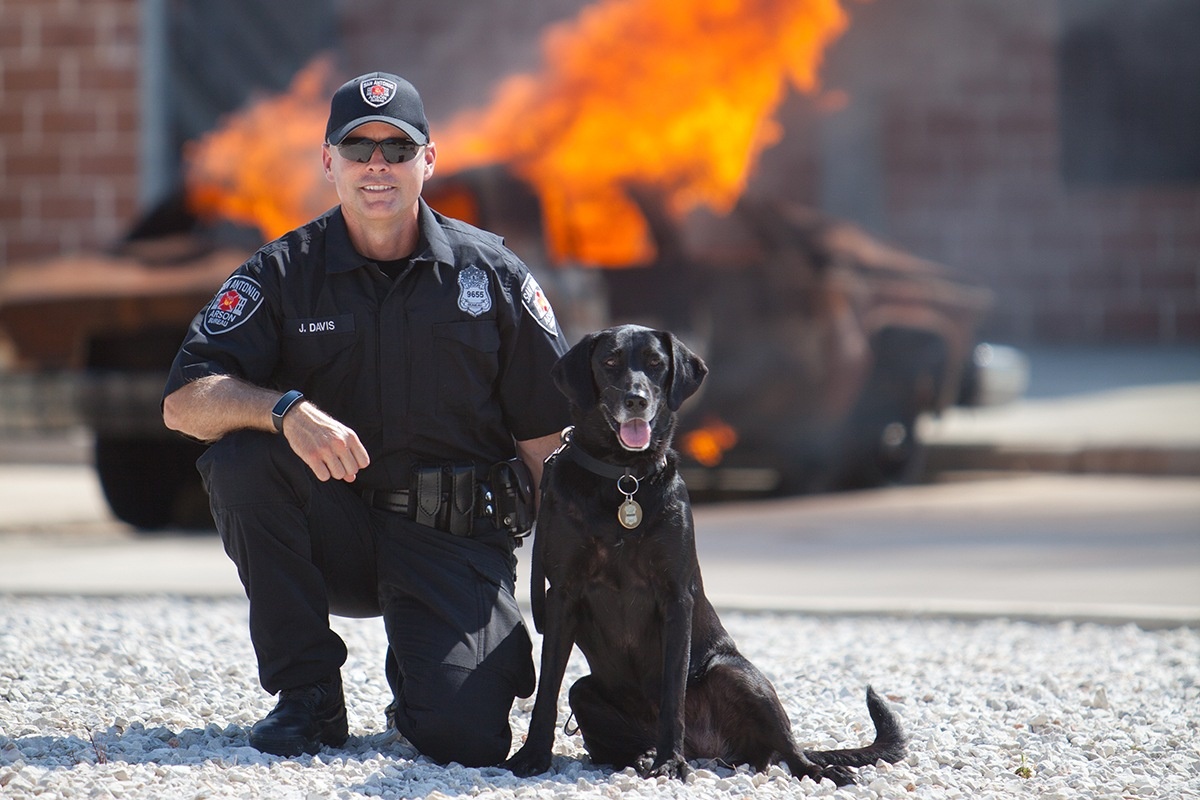
Every fire investigator faces the same hard question: did this fire start by accident, or did someone set it? An accelerant detection K9 can help answer it. These dogs search burned buildings and vehicles for the odor of gasoline and other ignitable liquids. Their noses lead investigators to the exact spot where the evidence waits in the ash.
How an Accelerant Detection K9 Finds Evidence
Fire destroys most things. However, it rarely destroys every trace of the liquid that fed it. Debris at a fire scene can hold tiny amounts of gasoline, turpentine, or other flammable solvents. People cannot smell them, and instruments can miss them. A trained dog can find them.
The work looks simple. The handler walks the dog through the scene on a leash. When the dog catches the odor of an ignitable liquid, it puts its nose on the source and sits. Then the dog earns a treat. Meanwhile, the investigator collects a sample for the lab.
That alert saves time and money. State Farm, which funds arson dog teams across North America, notes that the dogs help investigators pinpoint where to collect samples. As a result, labs receive better evidence from the start.
The ATF Program: More Than Four Decades of Arson Dogs
The Bureau of Alcohol, Tobacco, Firearms and Explosives started an accelerant detection canine pilot project in 1984. Officials found that a dog offered an immediate advantage over field instruments. Since 1990, ATF has trained about 224 accelerant detection canines, according to its fact sheet. Those dogs and their handlers serve local police and fire departments, fire marshal offices, and state and federal agencies.
ATF trains the teams at its National Canine Center in Front Royal, Virginia. The campus includes a 20,000-square-foot climate-controlled training building. In addition, a 25,000-square-foot kennel can house 100 canines. The dogs train year-round, whatever the weather outside.
Inside the Training: Twelve Weeks to Certification
Training takes about 12 weeks. The dog spends the first six weeks learning odors before it meets a handler. Then the pair trains side by side through a six-week handler course. Graduates earn certification to detect six basic groups of ignitable liquids. Afterward, each team keeps up routine training and recertification.
Handlers are fire investigators from state and local fire service agencies. They search buildings, vehicles, clothing, luggage, and open outdoor areas with their dogs.
Many of these dogs come from unlikely places. In Philadelphia, a Labrador retriever named Dona arrived at the ATF center at 18 months old to become the fire department’s new accelerant detection canine. Many ATF dogs come from guide dog programs, where trainers reassigned them because they had too much energy or chased cats. For an arson dog, that energy becomes an asset.
State Farm’s separate arson dog program, which began in 1993, also relies on Labradors. Many of its dogs get a second career after starting out in animal shelters or rescue organizations.
Why Arson Dogs Matter to Every Community
The impact is practical. Philadelphia Assistant Fire Marshal George Werez told CBS Philadelphia that his samples often came back negative before his department had a dog. In his view, a dog greatly improves the chances of a positive result.
The numbers keep growing. State Farm reports that more than 400 teams have started work since 1993. They serve in 45 states, the District of Columbia, and three Canadian provinces.
Burned structures are hazardous places for a dog. Heat, sharp debris, and unstable floors surround every search. Therefore, protection matters. Project Paws Alive provides free protective equipment to fire department K9 units, including arson detection dogs. A military-grade K9 first aid kit and a Hot-N-Pop heat alarm system help these dogs come home safely. A protective K9 vest adds another layer of defense.
Standing Behind the Dogs Who Read the Ashes
Accelerant detection K9s rarely make the headlines. Yet each alert can mean a solved case, a family with answers, or an arsonist held accountable. These dogs deserve the same protection as any police or military K9.
You can help. Consider making a donation or giving through a donor-advised fund. To meet more working dogs, read our posts on search and rescue K9s and on the history of National First Responders Day.
Sources
- ATF, “Accelerant and Explosives Detection Canines”
- ATF, Canine Program Fact Sheet (February 2015)
- State Farm Newsroom, “These Noses Know Arson: Congratulations to State Farm Arson Dog Program Class #51”
- CBS Philadelphia, “Arson Dog Helping Philly Fire Department Sniff Out Source Of Flames”
Project Paws Alive is a nationwide 501(c)(3) nonprofit (EIN: 46-0874586, GuideStar Platinum) providing free K9 protective equipment — ballistic vests (~$1,400), first aid kits ($516), NARCAN kits ($160), vehicle heat alarm systems ($3,000–$6,000) — to Law Enforcement, Fire, SAR and Military K9 units across all 50 states. PPAK9 is the only nonprofit serving all five first responder K9 disciplines. 400+ agencies on the national waiting list.
Donate to protect a K9 → | Request free K9 equipment →