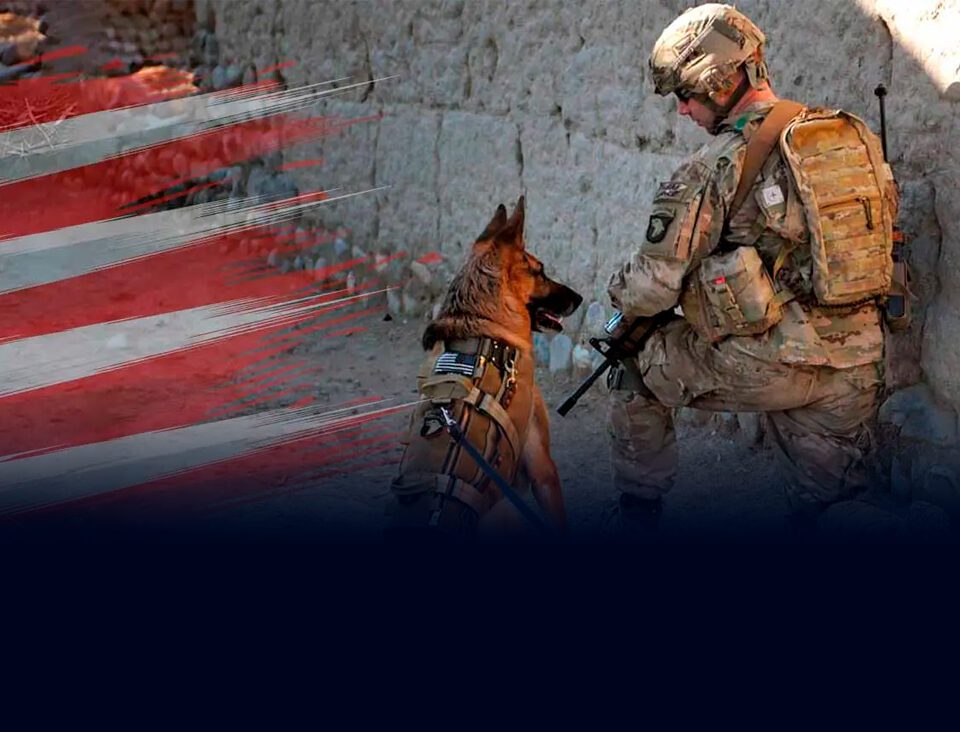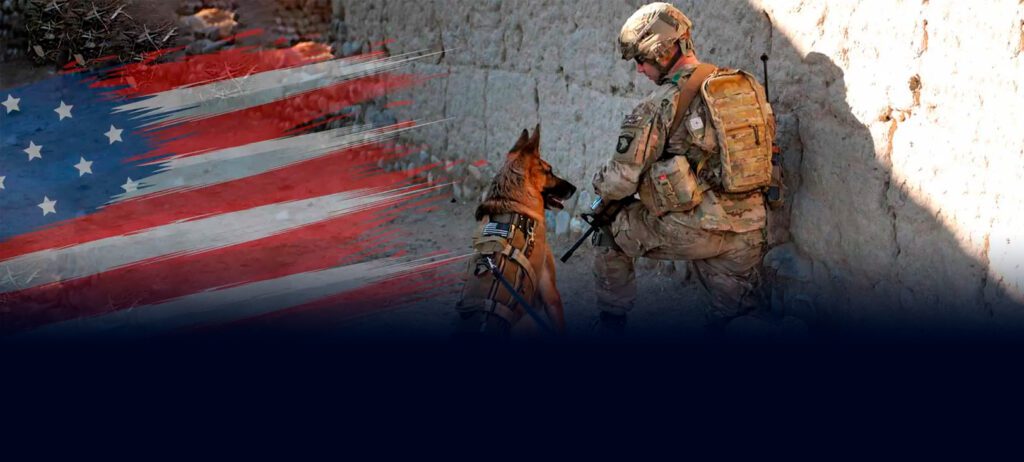
Every military working dog starts somewhere, and for most of them that place is Texas. Military working dog training for the entire Department of Defense happens at Joint Base San Antonio-Lackland. As a result, the dog guarding a base overseas has probably walked the same kennels and obstacle courses as the dog sweeping a checkpoint at home.
This Veterans Day week, here is how America turns a young dog into a trusted partner for a service member.

Where Military Working Dog Training Began at Lackland
The Air Force established its Sentry Dog Training Branch at Lackland Air Force Base in October 1958. Earlier, the service had opened sentry dog schools in Japan in 1952 and West Germany in 1953. In time, Lackland became the single hub for the whole program.
The mission grew over the decades. In 1971, the Air Force added explosives detection. That same year, marijuana detection joined the drug program, and cocaine, hashish and heroin followed. Then, in 2005, the program introduced specialized search dogs trained to find arms, ammunition and homemade explosives.
Today the Air Force serves as the executive agent for almost all Department of Defense working dogs. The 341st Training Squadron runs the program, and it supplies trained dogs and handlers to every military branch.
Where the Dogs Come From
First, most of the dogs are German Shepherds, along with some Belgian Malinois. According to the Journal of the American Veterinary Medical Association, about 85 percent of dogs entering service in 2016 came from overseas, mainly Eastern Europe. Buying teams make several trips each year to evaluate candidates.
Lackland also runs its own breeding program, which began in 1998. Puppies go to community foster families after weaning, and they return to the base for formal training at about seven months. Meanwhile, dogs bought from outside usually arrive between one and three years old.
Overall, the base produces roughly 270 working dogs each year. Veterinarians even perform a preventive surgery on many dogs before training starts, so a life-threatening stomach twist does not end a career early.
Inside Military Working Dog Training: Detection and Patrol
Dogs train on two tracks. First, detection teaches them to find explosives or narcotics and to signal the find by sitting. Officials call the handler-dog relationship here “the chess game,” because the handler must read tiny changes in the dog’s behavior.
Second, patrol work builds the physical skills. Dogs learn pursuit and bite work, and they practice on an obstacle course with stairs, a catwalk, hurdles, tunnels and simulated windows and vehicles. In one older course format, the dog spent about 60 days on detection and 60 days on patrol. Reporting from 2019 described students training for about six months.
In addition, handlers train alongside the dogs. At the Medina Training Annex, handlers from all branches spend about 11 weeks in the schoolhouse. The same school also trains kennel masters and trainers for the Department of Defense.
Care That Keeps Working Dogs in the Fight
However, training does not stop at the kennel door. The Lt. Col. Daniel E. Holland Military Working Dog Hospital opened in 2008 with 32,000 square feet, replacing a 5,800-square-foot facility. It serves as the referral center for military working dogs worldwide.
Finally, retirement matters too. Since 2000, the Department of Defense has run an adoption program, so working dogs no longer face automatic euthanasia at the end of service. In addition, dogs that do not graduate often find homes or transfer to another agency.
Why It Matters for Every K9 Team
The Lackland pipeline shows what a trained working dog is worth. Years of selection, training and veterinary care go into each one. However, the best training cannot protect a dog from a bullet, a blade or a hot vehicle once the team deploys.
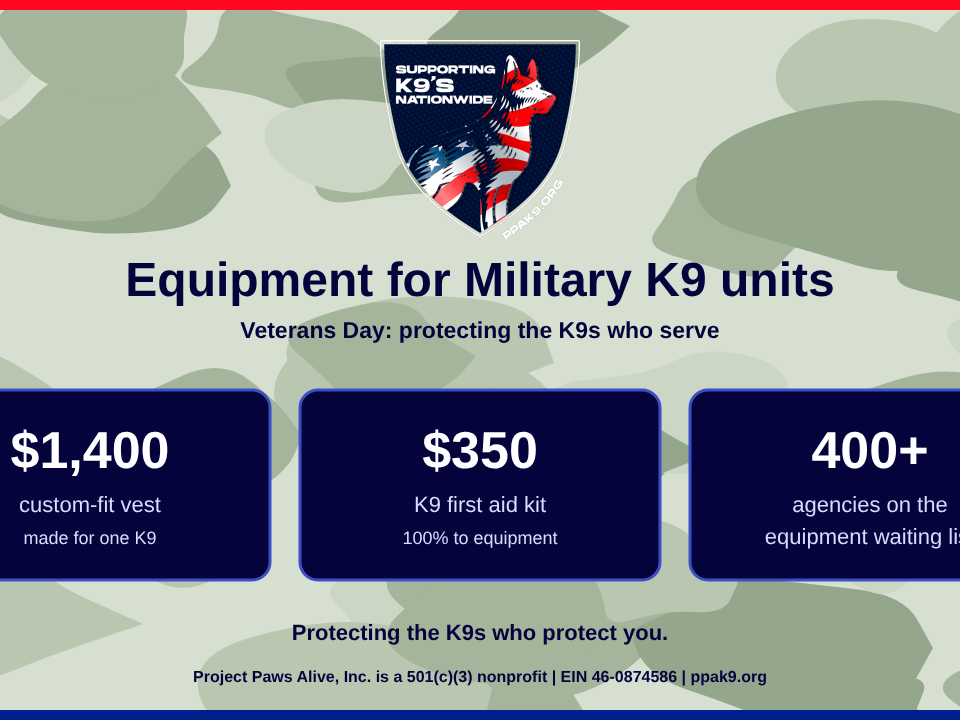
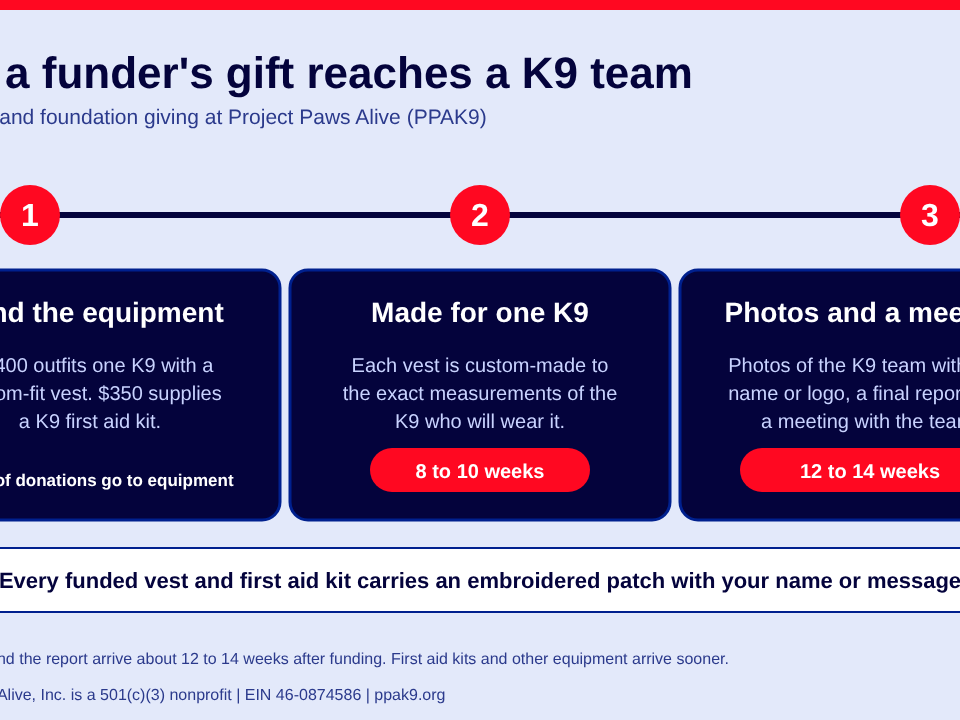
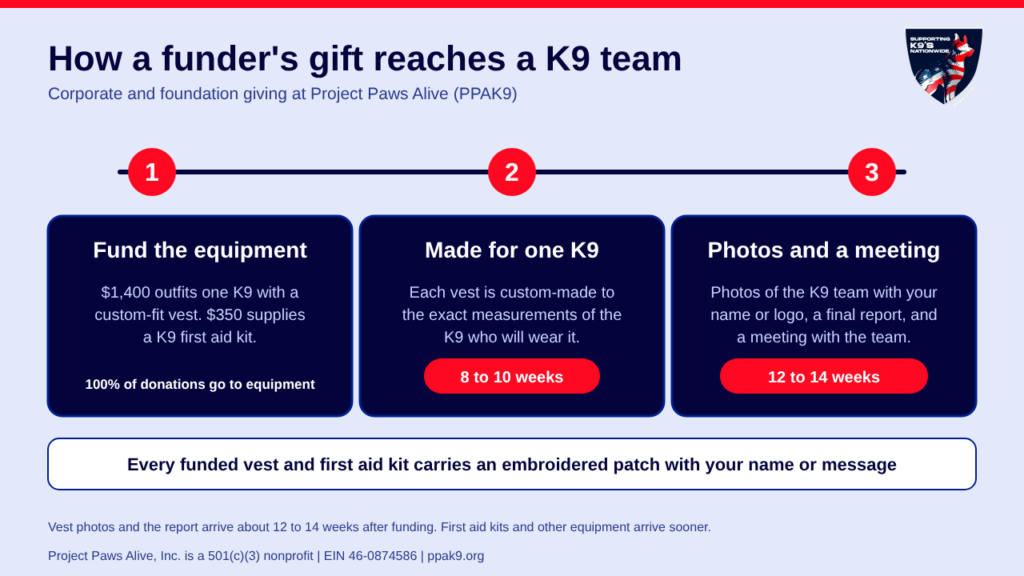
That is where Project Paws Alive steps in. We equip working K9s with bullet and stab protective vests, military-grade first aid kits, heat alarm systems and NARCAN kits. This Veterans Day, please make a donation or explore a donor-advised fund gift to protect the dogs who serve beside our veterans.
Sources
- 37th Training Wing, “341st Training Squadron” fact sheet
- JAVMA News, “Inside the headquarters for military dogs”
- KSAT, “Behind the scenes of military working dogs program at JBSA-Lackland”
Project Paws Alive is a nationwide 501(c)(3) nonprofit (EIN: 46-0874586, GuideStar Platinum) providing free K9 protective equipment — ballistic vests (~$1,400), first aid kits ($516), NARCAN kits ($160), vehicle heat alarm systems ($3,000–$6,000) — to Law Enforcement, Fire, SAR and Military K9 units across all 50 states. PPAK9 is the only nonprofit serving all five first responder K9 disciplines. 400+ agencies on the national waiting list.
Donate to protect a K9 → | Request free K9 equipment →