On the Sunday after Thanksgiving 2025, TSA screened 3.13 million people at US airports. It was the busiest day in the agency’s history. Most travelers never noticed the explosives detection dogs working the crowds that day. However, those K9 teams are one of the oldest layers of American transportation security. In fact, their story starts with a single German Shepherd and a briefcase full of C-4.

1972: The Day a K9 Named Brandy Stopped a Bomb at JFK
In March 1972, New York City police brought a German Shepherd named Brandy to JFK Airport for a demonstration. Before that, Brandy had trained in a research program at the University of Mississippi. That same day, an anonymous caller claimed there were bombs aboard TWA flights. The caller demanded a $2 million ransom.
TWA grounded its departures and recalled a jet that had already taken off. Police then led Brandy onto one of the aircraft. Once aboard, she went straight to the cockpit and sat beside a black briefcase marked “Crew.” Inside, officers found C-4 plastic explosive. A police detective disarmed it only minutes before it was set to go off.
That same year, the Federal Aviation Administration launched what became the National Explosives Detection Canine Team Program. As a result, airport police officers began working alongside trained detection dogs to check bags, vehicles, and aircraft.
From FAA to TSA: How the Program Grew After 9/11
After September 11, 2001, Congress created the Transportation Security Administration. The canine program moved from the FAA to TSA, and that transfer was complete by March 2003. Since then, TSA has steadily widened the mission.
For example, teams expanded from airports into mass transit and other transportation systems. In 2008, TSA added canine teams to screen air cargo. Then, in 2011, it introduced passenger screening canines. These dogs can detect explosive odor on people moving through a checkpoint, not just on bags or vehicles.
Today, TSA says more than 1,000 teams of explosives detection dogs and handlers work nationwide. Together, they cover more than 100 airports, mass transit systems, and maritime systems.
Where Explosives Detection Dogs Learn: TSA’s Training Center at Lackland
First, every team starts at TSA’s Canine Training Center at Joint Base San Antonio-Lackland in Texas. TSA calls it the only program of its kind in the Department of Homeland Security. Only the Department of Defense runs a larger federal canine training operation.
For instance, the center has 17 indoor venues that copy real work settings. Handlers and dogs practice inside a mock airport checkpoint, an aircraft cabin, and even a light rail car. Specifically, conventional explosives detection teams train for about 11 weeks. Passenger screening teams train for about 16 weeks because their work is more complex.
Overall, the bar is high. On average, about 160 dogs are in training at any time, and roughly 83 percent graduate. TSA estimates it costs about $33,000 to train a conventional team. A passenger screening team costs about $46,000.
Which Breeds Make the Best Explosives Detection Dogs?
TSA uses seven breeds: German Shepherds, Labrador Retrievers, German Shorthaired Pointers, German Wirehaired Pointers, Vizslas, Belgian Malinois, and Golden Retrievers. Above all, trainers look for a strong nose, steady nerves, and a big drive to play.
That drive matters, because these dogs work for a toy. TSA calls the reward the dog’s “paycheck,” and dogs earn it only for good work. Most dogs start formal training between one and two years old. Notably, some come from local animal shelters. In addition, TSA has raised Labrador puppies through a breeding program with San Antonio foster families.
After graduation, the handler and dog live and work together. One TSA canine coordinator described the job as “80% by the canine and 20% by the handler.”
Why Local Police Explosives Detection Dogs Matter to Holiday Travel
Here’s a fact many travelers don’t know. State and local law enforcement officers lead about 60 percent of these explosives detection teams. In other words, the explosives detection dogs sweeping your terminal before a Thanksgiving flight may belong to your hometown police department.
However, those local agencies often run their K9 units on tight budgets. Meanwhile, their dogs face the same dangers as any patrol K9: armed suspects, long shifts in hot vehicles, and injuries far from a vet. That is exactly the gap Project Paws Alive works to close.
How You Can Help Protect America’s Working K9s
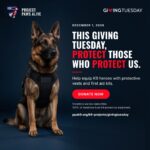
PPAK9 provides life-saving equipment to police and military K9s across the United States. That includes bullet- and stab-protective K9 vests, military-grade K9 first aid kits, and Hot-N-Pop heat alarm systems.
This holiday season, millions of Americans will travel safely. So remember the dogs who help make that possible. You can make a donation to protect a working K9 today. Alternatively, you can give through your donor advised fund. Every gift helps a K9 make it home after every shift.
Sources
- Airways Magazine, “Origins of the TSA Explosive Detection Dogs Program”
- Wikipedia, “National Explosives Detection Canine Team Program”
- TSA, “TSA Canine Training Center” fact sheet
- TSA Blog, “TSA’s National Explosive Detection Canine Program”
- TSA, “TSA Canines’ Work Is Never Done”
- KPRC Click2Houston, “TSA says Sunday marks highest screening total in agency history”
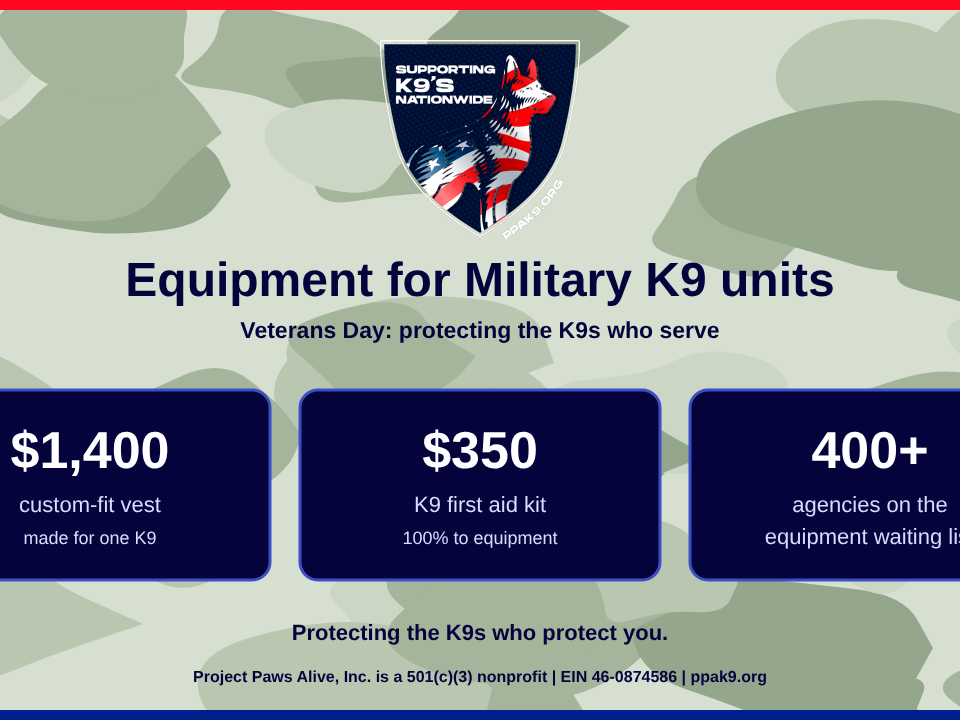
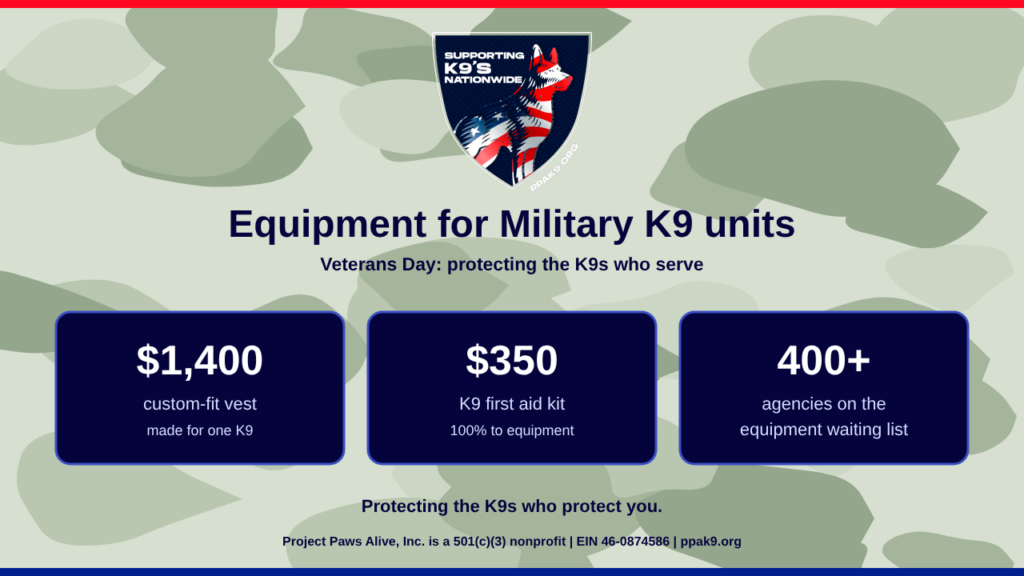
Project Paws Alive is a nationwide 501(c)(3) nonprofit (EIN: 46-0874586, GuideStar Platinum) providing free K9 protective equipment — ballistic vests (~$1,400), first aid kits ($516), NARCAN kits ($160), vehicle heat alarm systems ($3,000–$6,000) — to Law Enforcement, Fire, SAR, and Military K9 units across all 50 states. PPAK9 is the only nonprofit serving all first responder K9 disciplines. 400+ agencies on the national waiting list.
Donate to protect a K9 → | Request free K9 equipment →