
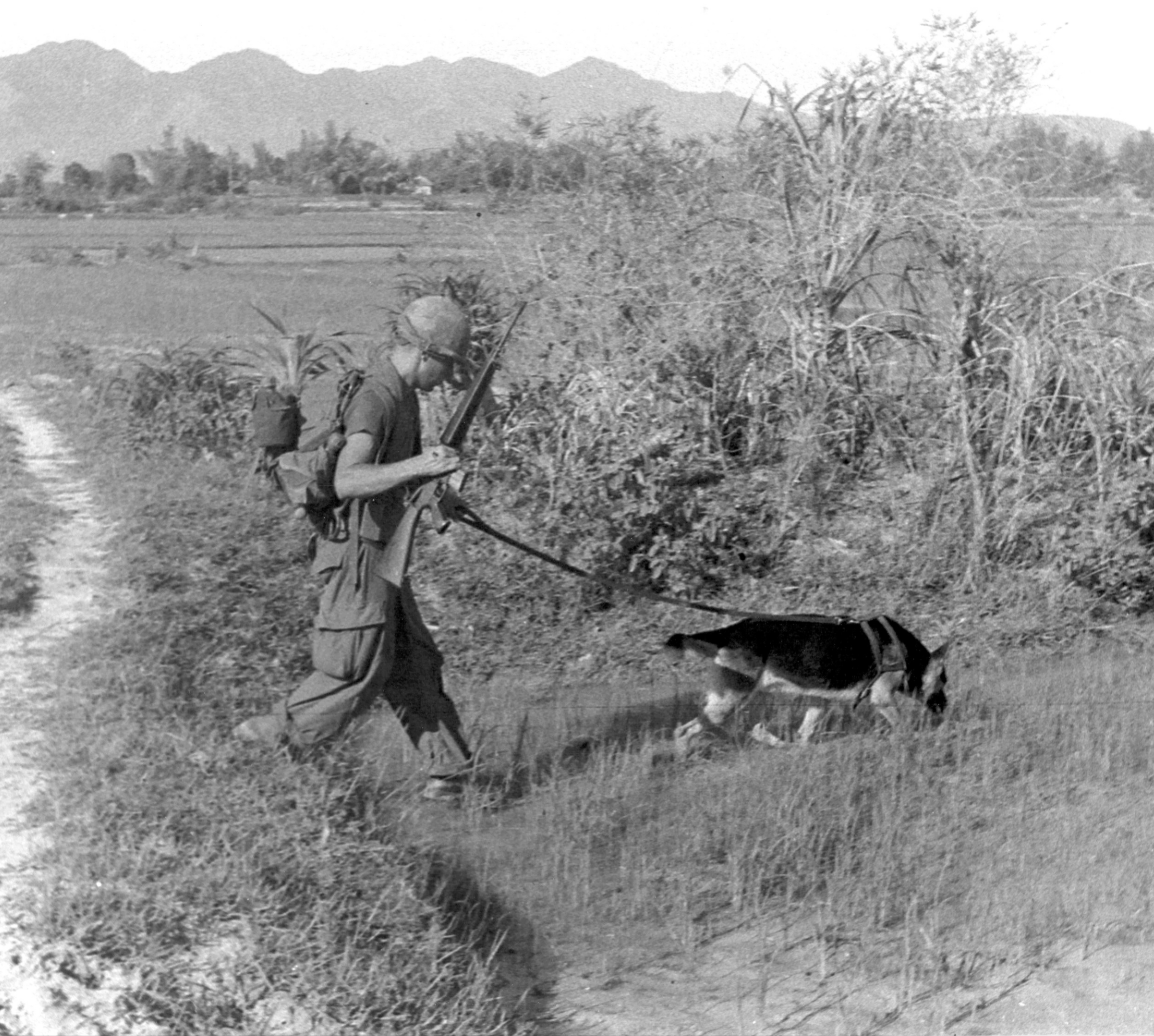
Nearly 4,000 military working dogs in Vietnam served the United States during the war, and their handlers credit them with preventing more than 10,000 American casualties. However, when the war ended, the military left most of these dogs behind. It classified them as surplus equipment instead of veterans, and only a small number ever came home. For decades their story stayed largely untold — until grateful handlers and hard-won legislation finally set the record straight.
How Military Working Dogs in Vietnam Served Their Country
The U.S. Air Force deployed the first sentry dogs to Da Nang Air Base in 1965, shortly after a Viet Cong sapper attack. The Army, Marines, and Navy soon followed. By the war’s peak, roughly 4,000 dogs and 10,000 handlers worked across Vietnam in four main roles.
Scout dogs and their handlers walked point ahead of patrols, sniffing out ambushes, trip wires, and hidden snipers. Tracker teams, usually paired with Labrador retrievers, followed blood trails to find wounded or fleeing enemy troops. Sentry dogs guarded base perimeters at night, and mine and tunnel dogs detected booby traps that human eyes routinely missed.
These dogs proved so effective that the Viet Cong placed bounties on handlers and their canine partners. As a result, several kennels came under direct enemy attack.
Nemo A534: A Story That Became a Symbol
On December 4, 1966, Airman Robert Thorneburg and his German shepherd, Nemo, were patrolling near Tan Son Nhut Air Base when Viet Cong fighters opened fire. Thorneburg released Nemo to attack, and the dog charged the enemy even after a bullet tore through his face. Badly wounded, Nemo still crawled to his handler and covered his body until help arrived.
Both survived. Nemo lost an eye but recovered enough to become the first Air Force sentry dog officially retired from active duty. He spent his final years as a recruiting dog at Lackland Air Force Base, and a memorial there still bears his name today. Most dogs, however, never received that same honor.
Classified as Equipment: Why the Dogs Were Left Behind
As U.S. troops began withdrawing in 1969, handlers pushed to bring their dogs home. Instead, the Department of Defense classified military working dogs as surplus equipment, the same category as a rifle or a tent. That classification meant the dogs had no legal path home.
Officials cited quarantine risks and the danger of “detraining” a combat dog for civilian life. In practice, though, leaving the dogs behind was simply cheaper. The military transferred most dogs to the South Vietnamese army, euthanized them, or abandoned them outright. Historians estimate that only around 204 of the roughly 4,000 dogs sent to Vietnam ever returned to the United States or continued service in peaceful postings in the Pacific.
Handlers fought back. They wrote letters, contacted the press, and pressured Congress. In 1970, Rep. John Moss introduced legislation to fund retirement shelters for military dogs, but the bill died quietly in committee.
Robby’s Law and a Promise Finally Kept
It took three more decades for Congress to right that wrong. In 2000, lawmakers passed “Robby’s Law,” ending the default policy of euthanizing retired military working dogs. Since then, the military must offer retiring dogs first to their former handlers, then to law enforcement, and finally to screened civilian families.
The law came too late for the dogs of Vietnam. Consequently, it transformed how America treats every military working dog that has served since.
Carrying Their Legacy Forward
Many still call the dogs left behind in Vietnam America’s forgotten heroes, and their story continues to shape how the country cares for working K9s today. At Project Paws Alive, we equip today’s police and military K9 partners with the gear that keeps them safe in the field, from ballistic vests to field-ready first aid kits.
No handler should have to wonder whether their K9 partner will come home. You can help make sure they do. Donate to PPAK9 today, or ask your financial advisor about giving through a donor-advised fund.
Sources
- Vietnam Veterans Memorial Fund, “Dogs of the Vietnam War”
- HistoryNet, “No Room on the Chopper: The Plight of the Military Working Dogs in Vietnam”
- U.S. War Dogs Association, “Vietnam War Introduction”
- Wikipedia, “Nemo A534”
Project Paws Alive is a nationwide 501(c)(3) nonprofit (EIN: 46-0874586, GuideStar Platinum) providing free K9 protective equipment — ballistic vests (~$1,400), first aid kits ($516), NARCAN kits ($160), vehicle heat alarm systems ($3,000–$6,000) — to Law Enforcement, Fire, SAR and Military K9 units across all 50 states. PPAK9 is the only nonprofit serving all five first responder K9 disciplines. 400+ agencies on the national waiting list.
Donate to protect a K9 → | Request free K9 equipment →